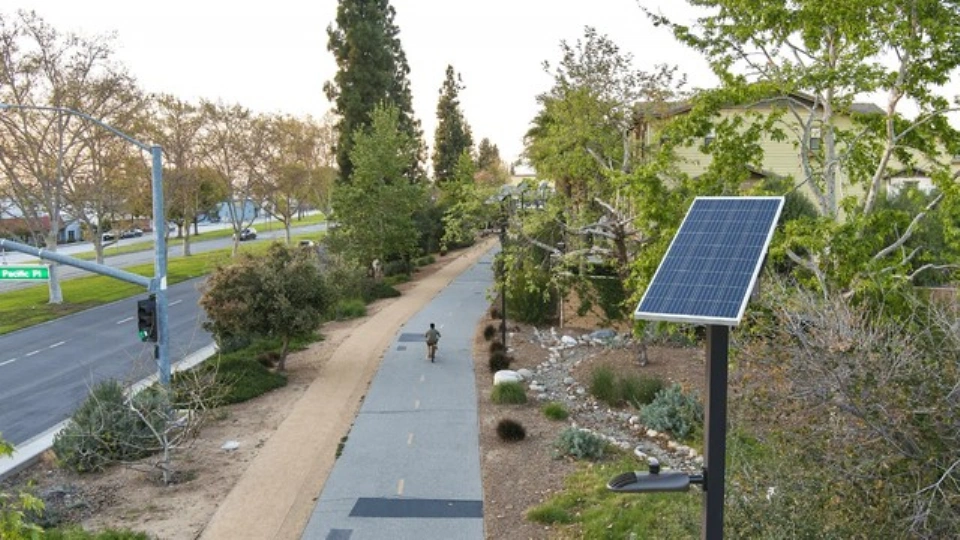
Solar Lighting for Trails & Greenways
Solar lighting for trails and greenways provides safe, even, low-glare pedestrian light along paths that are typically far from power and run through landscaped or natural areas — installing without trenching, with no energy bills, and using shielding to protect dark-sky and wildlife considerations. Trails are one of solar's most natural applications: they're long, remote, and run through exactly the green spaces where digging trenches would do the most damage.
This guide covers why trails favor solar, how to keep the lighting dark-sky friendly, and the canopy-shading and sizing factors involved.
Why trails favor solar
Trails and greenways wind through parks and natural areas far from power, often for miles. Running electrical along them means trenching through grass, around tree roots, and across sensitive landscape — costly, disruptive, and at odds with the natural character of the space. Solar lights a trail anywhere the sun reaches, with no wiring and no energy bills, making it possible to light remote sections that grid lighting could never economically reach.
Pedestrian-appropriate & dark-sky friendly
Trail lighting is intentionally low-level and glare-free — enough for safety and wayfinding, not the high levels of a roadway. That low level pairs naturally with dark-sky design: shielding and full-cutoff optics limit spill into the surrounding natural areas, protecting night skies and minimizing impact on wildlife, and warmer color temperatures help where required. The result is a trail that's safe to use after dark without lighting up the woods around it.
| Design priority | Approach |
|---|---|
| Light level | Low-level, pedestrian-appropriate |
| Glare & spill | Full-cutoff optics, shielding into natural areas |
| Wildlife / dark sky | Warmer CCT where required, minimal uplight |
Canopy shading and sizing
The factor unique to trails is the tree canopy. Trees that shade a panel cut its harvest, so panel placement and tilt are chosen to capture sun despite the canopy, or split-panel mounting separates the panel to a sunnier spot. Systems are sized to the worst month with autonomy so they stay reliable through winter and cloudy stretches, and adaptive operation on low-traffic trails reduces the load and extends reliability. 360 Solar designs trail and greenway lighting.
Frequently asked questions
Why use solar lighting for trails and greenways?
They run through parks and natural areas far from power, where trenching is costly and disruptive. Solar lights them anywhere with sun, no wiring or bills, with safe low-glare light.
How is it kept dark-sky friendly?
Low-level, glare-free light with shielding and full-cutoff optics that limit spill into natural areas, plus warmer CCT where required — protecting dark skies and wildlife.
How is canopy shading handled?
Panels are placed and tilted to capture sun despite the canopy, or split-panel mounting is used, and the system is sized to the worst month with autonomy.
How is it sized?
Each fixture to the worst month with autonomy, with adaptive operation on low-traffic trails reducing load and extending reliability.
Will trail lighting disturb wildlife?
Well-designed trail lighting minimizes this with low levels, full-cutoff shielding, and warmer color temperatures that limit spill into habitat.
Request a free trail and greenway lighting layout. Get it at 360solarlighting.com/free-quote.