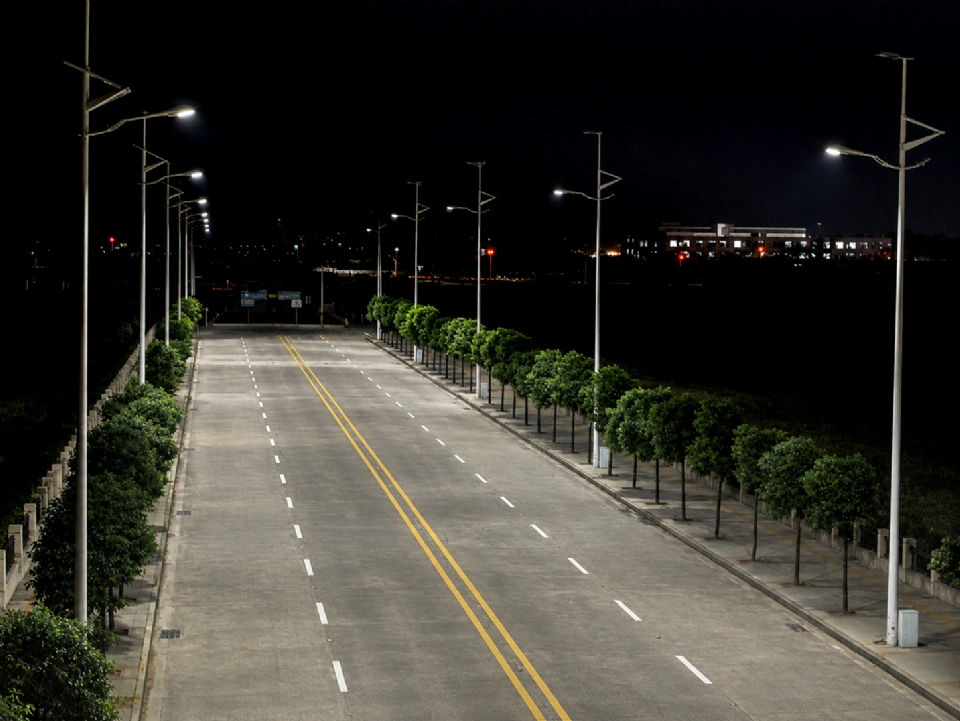
Solar Lighting Pole Spacing & Layout
Solar light pole spacing is set by mounting height, fixture output, optical distribution, and the target light level and uniformity — commonly around 80–150 feet for streets, with taller poles and the right distribution allowing wider spacing. A photometric layout determines the exact spacing to avoid dark gaps. The twist with solar is that spacing decisions interact with the solar system itself: wider spacing means fewer but higher-output poles, each carrying a larger solar load.
This guide explains how spacing follows height and distribution, the cost-and-uniformity trade-off unique to solar, and why a photometric layout is essential.
Spacing follows height and distribution
A common engineering guideline relates spacing to mounting height — often about 3–4× the height for roadway distributions — with the optical distribution type (Type II, III, IV, or V) setting how far poles can space before uniformity suffers. Taller poles cover more area per pole, so they can be spaced farther apart; the distribution determines the shape of that coverage. A Type II or III roadway distribution spreads light along the road, supporting wider spacing than a symmetric area distribution would.
| Factor | Effect on spacing |
|---|---|
| Mounting height | Taller = wider spacing (~3–4× height) |
| Fixture output | Higher output covers more area |
| Distribution type | Roadway optics allow longer spacing |
| Target level / uniformity | Tighter targets = closer spacing |
The cost-and-uniformity trade-off (with a solar twist)
The general trade-off is familiar: fewer poles (taller, wider spacing) lowers cost but risks dark gaps; closer spacing improves uniformity at higher cost. Solar adds a wrinkle. Fewer poles means fewer solar systems to install and maintain — an advantage — but each of those poles may need to be higher-output to cover more area, which raises its individual solar load (bigger panel and battery). So you can't optimize spacing in isolation; the pole count, fixture output, and per-pole solar load are balanced together.
Why a photometric layout is needed
Because all these variables interact, the only reliable way to set spacing is a photometric layout. It finds the spacing that holds the target uniformity at the lowest sensible pole count — no dark gaps, no wasted poles — and that result then feeds the solar sizing for each pole. Guessing at spacing risks either dark patches (a safety problem) or an over-built, over-priced system. 360 Solar produces a spacing-and-height layout for every project.
Frequently asked questions
How far apart should solar light poles be?
Commonly around 80–150 ft for streets, set by mounting height, fixture output, distribution, and target level/uniformity. A photometric layout sets the exact spacing to avoid dark gaps.
What determines spacing?
Spacing relates to mounting height (~3–4×) and the distribution type (II/III/IV/V), which sets how far poles can space before uniformity suffers.
How does spacing affect solar cost?
Fewer poles lowers cost but risks dark gaps and means higher-output poles with larger solar loads; closer spacing improves uniformity at higher cost — so the system is optimized together.
Why is a photometric layout needed?
It finds the exact spacing that holds uniformity at the lowest pole count, avoiding dark gaps while minimizing cost and solar load.
Does taller mounting always reduce cost?
Not always — taller poles cover more area (fewer poles) but each needs higher output and a larger solar system, so the layout balances both.
Request a free spacing-and-height layout for your project. Get it at 360solarlighting.com/free-quote.