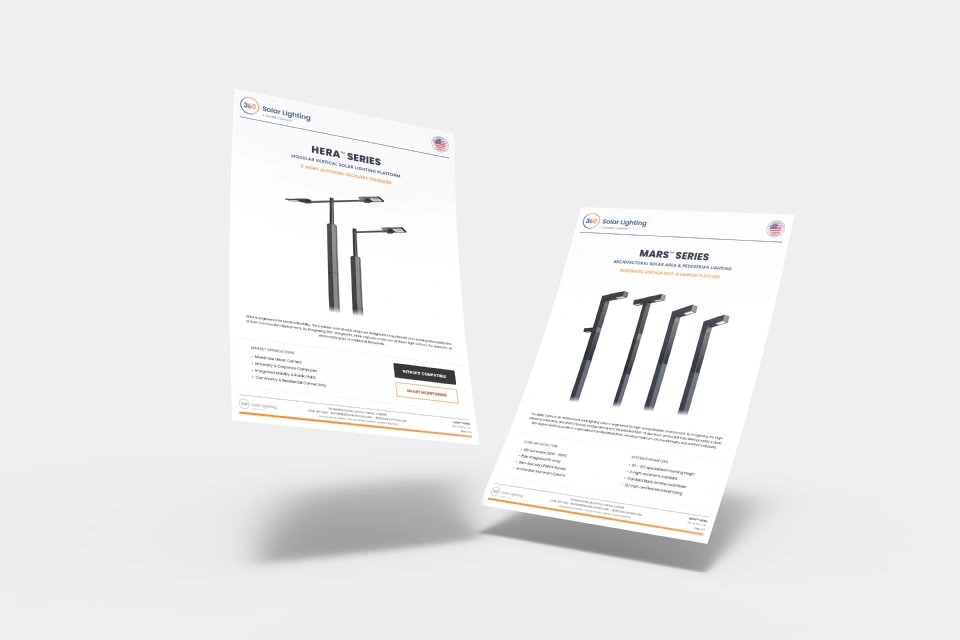
Solar Lighting Spec Sheets: What to Look For
A solar lighting spec sheet should state the LED wattage and delivered lumens/footcandles, panel wattage, battery chemistry and capacity (Wh/Ah), charge-controller type (MPPT), autonomy days, operating profile, IP/IK ratings, warranty with battery coverage, and the worst-month design basis. Anything missing is a red flag. The spec sheet is where catalog drop-shippers hide undersized systems, so knowing exactly what should be on it — and what its absence means — is the buyer's best defense.
This guide lists the must-have specs, shows how to read between the lines, and explains why the sheet alone isn't enough.
The must-have specs
| Category | Must-have specs |
|---|---|
| Light | LED watts, delivered lumens/footcandles, optics |
| Solar | Panel wattage, battery chemistry + capacity, MPPT controller |
| Performance | Autonomy days, operating profile, worst-month design basis |
| Durability | IP65/66, IK rating, materials |
| Warranty | Length and explicit battery coverage |
The performance row is the one that separates engineered systems from catalog products: autonomy days, the operating profile, and the worst-month design basis are what prove the system was sized for your site and season, not just pulled off a shelf.
Reading between the lines
The tell is what's not there. A sheet listing only wattage and lumens — with no battery capacity, no autonomy figure, and no worst-month basis — is hiding the engineering, and is very likely an undersized catalog product that will run fine in summer and fail in winter when the battery can't recharge. Light specs alone don't tell you whether the system can survive a cloudy December; only the battery, autonomy, and worst-month figures do. If those are absent, assume the worst and ask for them.
Don't rely on the sheet alone
Even a complete spec sheet describes a product, not whether it's right for your site. Pair the sheet with a photometric report (proving the light reaches the surface) and a sizing calculation (proving the panel and battery match the load and worst-month resource). And use a consistent template across vendors so bids are genuinely comparable — otherwise you're comparing differently-formatted marketing. 360 Solar provides full engineered specs alongside the photometric and sizing documentation.
Frequently asked questions
What should a solar lighting spec sheet include?
LED watts and delivered lumens/footcandles, panel wattage, battery chemistry and capacity, MPPT controller, autonomy days, operating profile, IP/IK ratings, warranty with battery coverage, and the worst-month design basis.
What does a missing spec indicate?
A sheet with only wattage and lumens — no battery capacity, autonomy, or worst-month basis — is hiding the engineering and is likely an undersized catalog product that fails in winter.
What are the must-have categories?
Light, solar (panel/battery/MPPT), performance (autonomy, profile, worst-month), durability (IP/IK), and warranty with battery coverage.
Should I rely on the spec sheet alone?
No — pair it with a photometric report and a sizing calculation, and use a consistent template so bids are comparable.
Why does the worst-month basis matter so much?
It proves the system was sized for the darkest month, which is what prevents winter failures; without it, the system may only work in summer.
Request a full engineered spec with photometric and sizing documentation. Get it at 360solarlighting.com/free-quote.