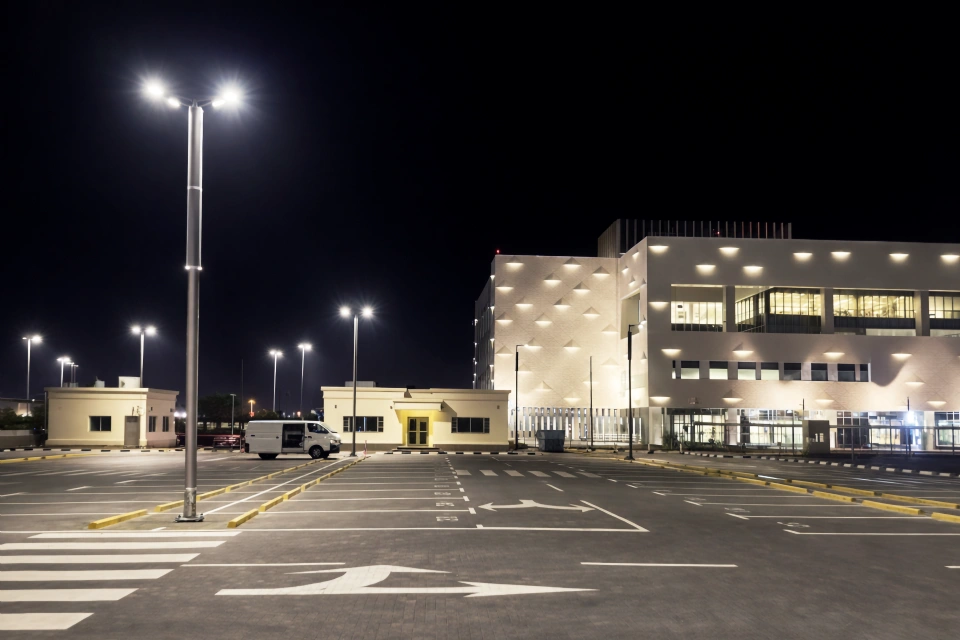
Designing Solar Parking Lot Lighting to IES Light Levels
Solar parking-lot lighting is designed to recognized IES light levels — typically a low average footcandle target with controlled uniformity for safety and security — and the engineering challenge is delivering those levels reliably from an off-grid system. The design follows the same IES practice as grid parking lighting, then adds the solar sizing.
This reference covers target light levels, uniformity and optics, and the solar layer.
Target light levels
Parking lighting follows IES guidance (RP-20/area practice), generally targeting a modest average (often ~1–2+ fc depending on activity and security) with a uniformity ratio that prevents dark pockets where the minimum is far below the average. Higher-security lots use higher levels. The target follows the lot's use and security needs.
Uniformity and optics
For parking, uniformity matters as much as average level — a lot with bright pools and dark gaps feels and is less safe than an evenly-lit lot at a lower average. Area optics (Type III/IV/V) spread light from each pole:
| Optic | Use |
|---|---|
| Type V | Open lots (symmetric spread) |
| Type III / IV | Edges and perimeters |
Pole height and spacing overlap enough to hold uniformity across the lot, eliminating dark gaps.
The solar layer
Each fixture's nightly load drives the solar sizing. The key lever is motion-adaptive operation — full light when occupied, dimmed when empty — which cuts the load and allows a smaller, cheaper system while preserving safety. The design follows the IES level first, then sizes the solar to power it through the worst month. 360 Solar designs to IES levels, then sizes the solar.
Frequently asked questions
What light levels do solar parking lots target?
IES guidance (RP-20/area practice) — typically ~1–2+ fc average with controlled uniformity, higher for security lots.
Why does uniformity matter as much as average level?
A lot with bright pools and dark gaps is less safe; the design prevents dark pockets where the minimum falls far below the average.
What optics are used?
Area optics — Type V for open lots, Type III/IV for edges — with pole height and spacing overlapping to hold uniformity.
How is the solar sized?
Each fixture's nightly load drives sizing, and motion-adaptive operation cuts the load to allow a smaller, cheaper system while preserving safety.
Does adaptive operation reduce safety?
No — full light returns on occupancy, and a safe dimmed baseline is held when empty.
Request a parking-lot solar layout. Get it at 360solarlighting.com/free-quote.