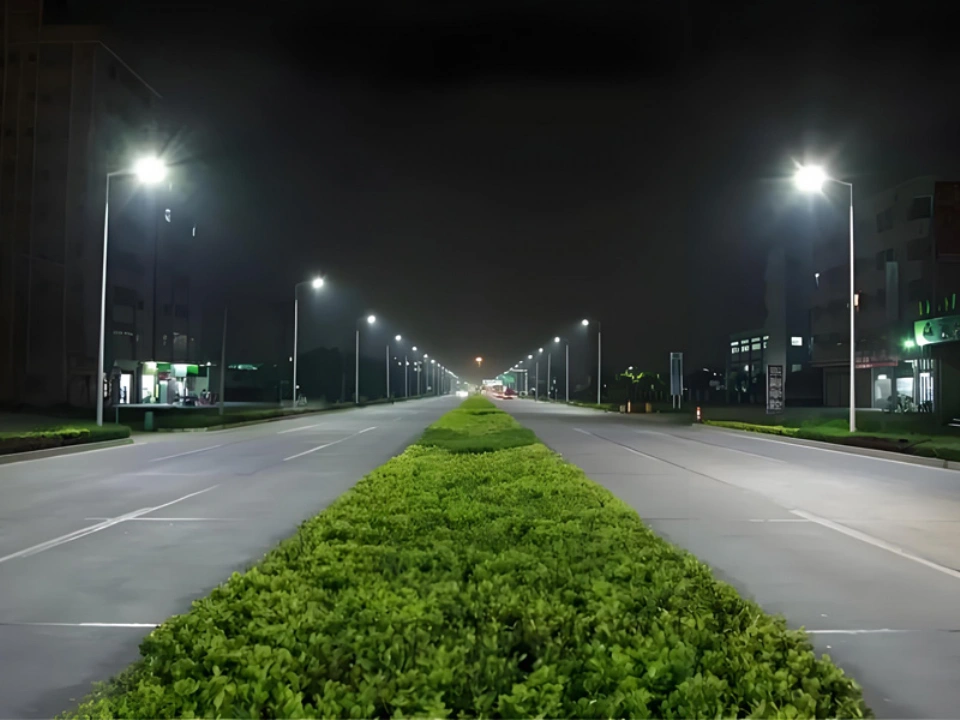
Pole Spacing, Mounting Height & Distribution for Solar Streets
Pole spacing, mounting height, and light distribution are one linked decision — taller poles with the right distribution cover more area per pole, but spacing must stay within the limits that hold uniformity — so getting the ratio right minimizes pole count without dark gaps. For solar, this decision also drives how big each pole's solar system must be.
This reference covers the spacing-to-height relationship, the cost/uniformity balance, and the solar-specific angle.
The spacing-to-height relationship
A useful rule relates spacing to mounting height (often ~3–4× height for roadway distributions), with the optical distribution (Type II/III/IV/V) setting how far poles can space before uniformity suffers. Taller poles cover more area per pole, allowing wider spacing — but only up to the limit the distribution can hold without gaps.
Balancing cost and uniformity
Fewer poles (taller, wider spacing) lowers cost but risks dark gaps if overdone; closer spacing improves uniformity at higher cost. The photometric study finds the spacing that meets the uniformity target at the lowest pole count — the optimum that avoids both dark gaps and wasted poles.
Solar-specific
| Choice | Solar implication |
|---|---|
| Fewer poles (wider spacing) | Fewer systems to install/maintain, but each higher-output (larger solar load) |
| More poles (closer spacing) | More systems, but each lower-output (smaller solar load) |
For solar, fewer poles means fewer systems to install and maintain — attractive — but each may then be higher-output, raising its solar load (bigger panel and battery). So spacing can't be optimized in isolation; the whole system (spacing, height, output, solar) is optimized together. 360 Solar produces a spacing/height layout per project.
Frequently asked questions
What determines solar pole spacing?
Mounting height (~3–4× for roadway distributions) and the distribution type (II/III/IV/V), which sets how far poles can space before uniformity suffers.
How do you balance cost and uniformity?
Fewer poles lowers cost but risks dark gaps; closer spacing improves uniformity at higher cost. A photometric study finds the optimum.
What's the solar-specific trade-off?
Fewer poles means fewer systems but higher per-pole output and solar load; the whole system is optimized together.
Why is a photometric layout needed?
Because spacing, height, output, and solar load interact, only a layout finds the spacing that holds uniformity at the lowest pole count.
Does taller mounting always cut cost?
Not always — fewer, taller poles each need higher output and a larger solar system, so the layout balances both.
Request a spacing/height layout. Get it at 360solarlighting.com/free-quote.