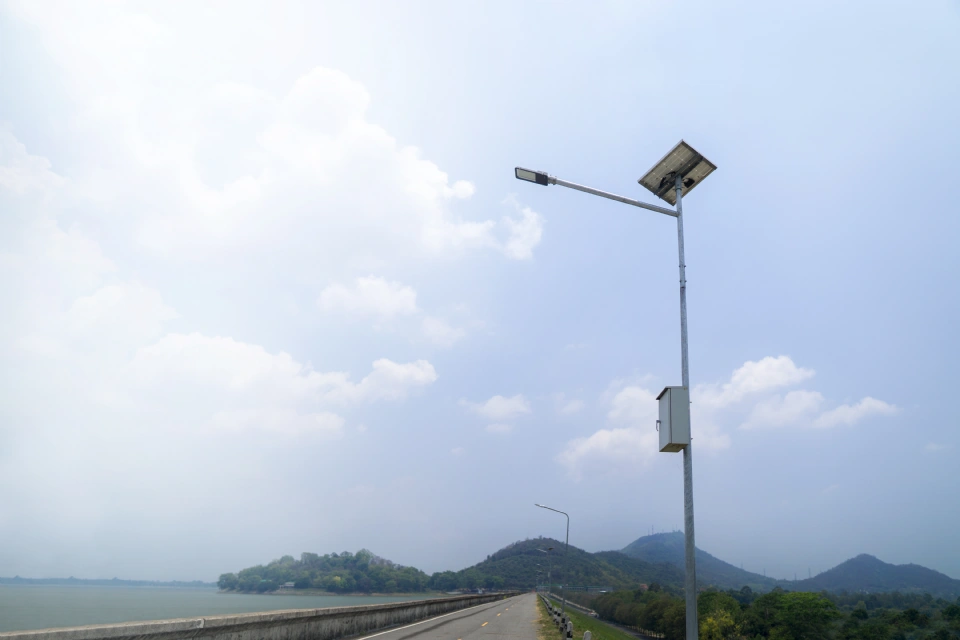
Photometrics for Solar Roadway Lighting (DOT Compliance)
Solar roadway lighting earns DOT approval the same way grid lighting does — by meeting the photometric requirements of IES RP-8 and AASHTO for the road's classification — so the solar system must be sized to power a fixture that hits those levels every night. Solar changes the power source, not the standard.
This reference covers the standards first, the roadway optics, then the solar engineering.
Standards first
DOT and municipal roadway projects design to IES RP-8 (and AASHTO) using an illuminance method (footcandles/lux on the pavement) or a luminance method (cd/m² as the driver sees it), plus uniformity and veiling-luminance (glare) limits. The road classification sets the targets. Solar doesn't change any of this — it changes how the compliant fixture is powered.
Roadway optics
Meeting the target requires roadway distributions (Type II/III) that spread light along the road with controlled backlight and glare. The design models pole spacing, mounting height, and optics to satisfy the classification — the same photometric discipline a grid roadway project uses.
Then the solar engineering
| Step | Detail |
|---|---|
| 1. Meet the standard | Fixture and layout to RP-8/AASHTO |
| 2. Size the solar | Worst-month with autonomy and MPPT |
Once the fixture meets RP-8/AASHTO, the system is sized worst-month with autonomy and MPPT to run reliably year-round. The cardinal rule: cutting the light level to ease the solar math fails the standard — never down-spec the fixture to make the solar smaller. 360 Solar designs roadway projects to RP-8/AASHTO and supports documentation.
Frequently asked questions
How does solar roadway lighting meet DOT requirements?
By meeting IES RP-8/AASHTO photometric requirements for the road's classification, then sizing the solar system to power that compliant fixture every night.
What standards govern roadway lighting?
IES RP-8 and AASHTO, using an illuminance or luminance method plus uniformity and veiling-luminance (glare) limits.
What optics are used?
Roadway distributions (Type II/III) that spread light along the road with controlled backlight and glare.
Can you reduce the light level to ease the solar math?
No — that fails the standard. The fixture must meet RP-8/AASHTO; the solar is sized worst-month with autonomy and MPPT to power it.
Does solar change the roadway design target?
No — solar changes only the power source; the photometric target follows the road classification regardless.
Request a DOT-compliant roadway design. Get it at 360solarlighting.com/free-quote.